
I Found the Answers to All of Your Creative Problems
This edition is chock full of advice you didn't ask for, but I'm certain will help you.

What if the answer isn’t more of the same, but less? What if there’s more connection to the things we make than we originally thought? Imagine if the real answer to getting to the good work was as simple as sitting down.
This update was supposed to be a members-only post, but as I got into it, I realized the info was too good to not share with everyone. I’m not the master of these valuable lessons, but for reasons that will reveal themselves shortly, I either learned or re-acquainted myself with them in such a powerful way, it’s hard to imagine how I made anything before this moment.
Brute Force
I am nothing more than a clod; point me in a direction and I’ll trample my way through. When in doubt, I barreled my way into creativity, knocking over paint supplies, art tools, and empty sketch journals to put my grips into whatever thing I was making in that moment. That process can be fun at times, but it’s also energy consuming, often draining my creative batteries fast, sometimes to a fault where I end up not making anything for weeks or months.
I recently saw a pop artist on Instagram who has a similar method, except with every mark he made, he would throw his tools or other items in the studio at the painting. Every. Single. Time! I was exhausted by the end of it, and besides the highly performative nature of it, I just couldn’t imagine doing that same schtick every single day.
When I started July’s sketching project, I started with brute force, and the results are obvious. I wasn’t happy and grew tired of it quickly. I thought about stopping early, but I didn’t want to go back on my personal commitment. Instead of brute force, though, I went looking for assistance, and it came in the form of an empathetic British artist on YouTube who led me to the first lesson.
Simple, Thoughtful, Momentum
There’s a phrase used in auto racing, “Slow is fast.” That counterintuitive statement is at the core of racing, and it’s why some people are fast racers while others win races. Winning is less about speed and more about fluidity. It’s about knowing what you car can do, what it can’t do, and using the stability and momentum of the car to get around turns efficiently, instead of hauling ass in the straights only to burn down the brakes at every corner.
It’s why in the 1960s, the Mini Cooper S won a significant amount of races against the Ford Falcons and Mercedes 300s of the era. Though the Minis would fall behind in the straight-aways, they would pull ahead in the corners of Monte Carlo (which there are many) because of stability and momentum.
You may not care about auto racing, but this week I learned how to sketch like a Mini Cooper, using efficiency and momentum to carry me through each line. I learned to begin with simplicity, finding the basic shapes of the subject instead of running toward accuracy. I used slow, steady movements to add simple details, and as the image began to take shape, I finished with shadows and highlights to bring the images to life.
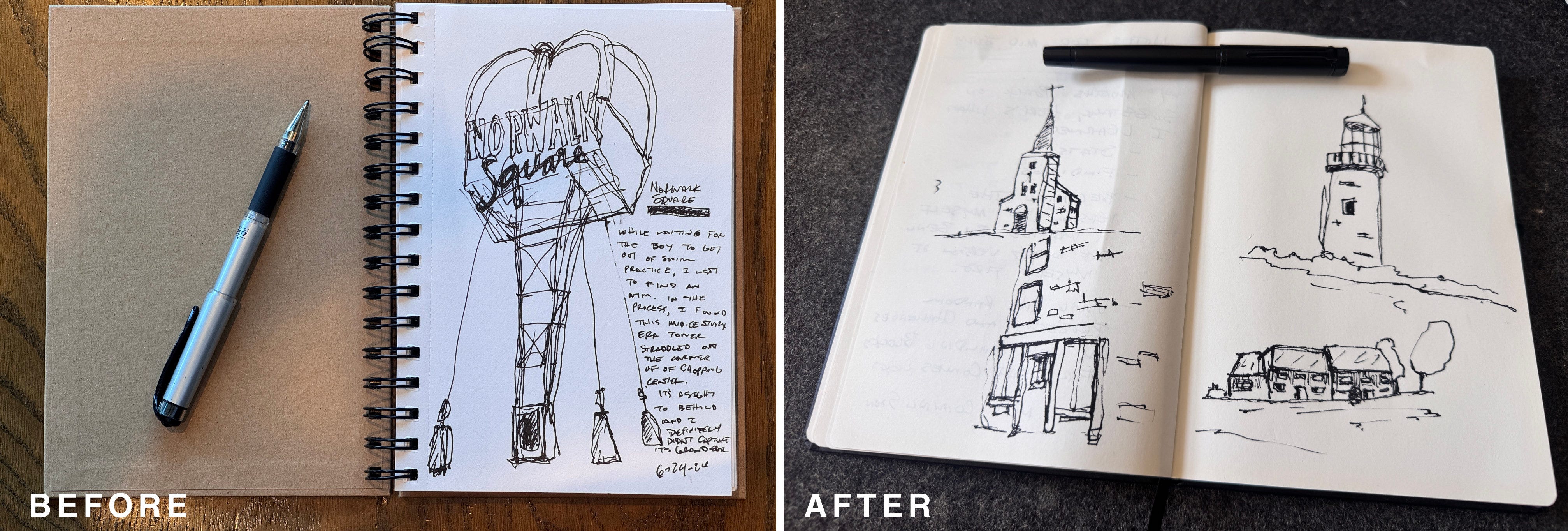
I’m still a long way from being great at sketching, but comparing these two images side by side, I can see how simplifying my technique has taken me through the curves of this challenge much quicker than I could with my previous technique.
This is bigger than just sketching, though. This week, I made my first mixed media collages in months, and without thinking about it, I made five in two full days.
Real Quick: Want to go deeper?
I work to bring quality content to all subscribers, and becoming a paid gets you some serious bennies. Free subscribers get twice a month updates, but members get:
A weekly dispatch, every Friday - The raw thinking behind whatever I’m working through that week, and behind-the-scenes work done in the shop as I rebuild my online sales.
The monthly creative challenge - Each month I try a creative impulse I haven’t mastered to see how it adds (or takes away) from my work. Free readers get the takeaway, but members get the process while it’s happening: the resistance, the almost-quitting, and the heroes journey (yeah, it’s like that).
Monthly digital asset pack - Texture and image packs pulled straight from my own camera roll. There’s no clip art to be found here, and it yours as part of membership, no extra charge.
First look at LostMixtape.com - The sales side of things, which is ever-evolving. I share my e-commerce experiences, new product drops, decisions before anyone outside this list sees them, and real-life strategies for selling creative goods.
Member-exclusive chat - Where the conversation happens away from the public comments. Also, direct line to me, always.
Finally, I’m a bit of a wild stallion, going off script (and apparently mixing my metaphors), and handing out goodies randomly whenever I get the impulse. No guarantees on that, but I feel a generous streak coming on… just saying.
Normally, this would be a member post, and if you want more, upgrade to Member status today and I’ll hand over some goodies right away.
This From That
I have a big project that I’m launching in September (members get this info sooner), and part of it will require a specific style of collage. Since I had not touched paper collage in a long time, I felt the need to practice. By the time you read this, I’ll be several collages deep, but I’m working much different than normal.
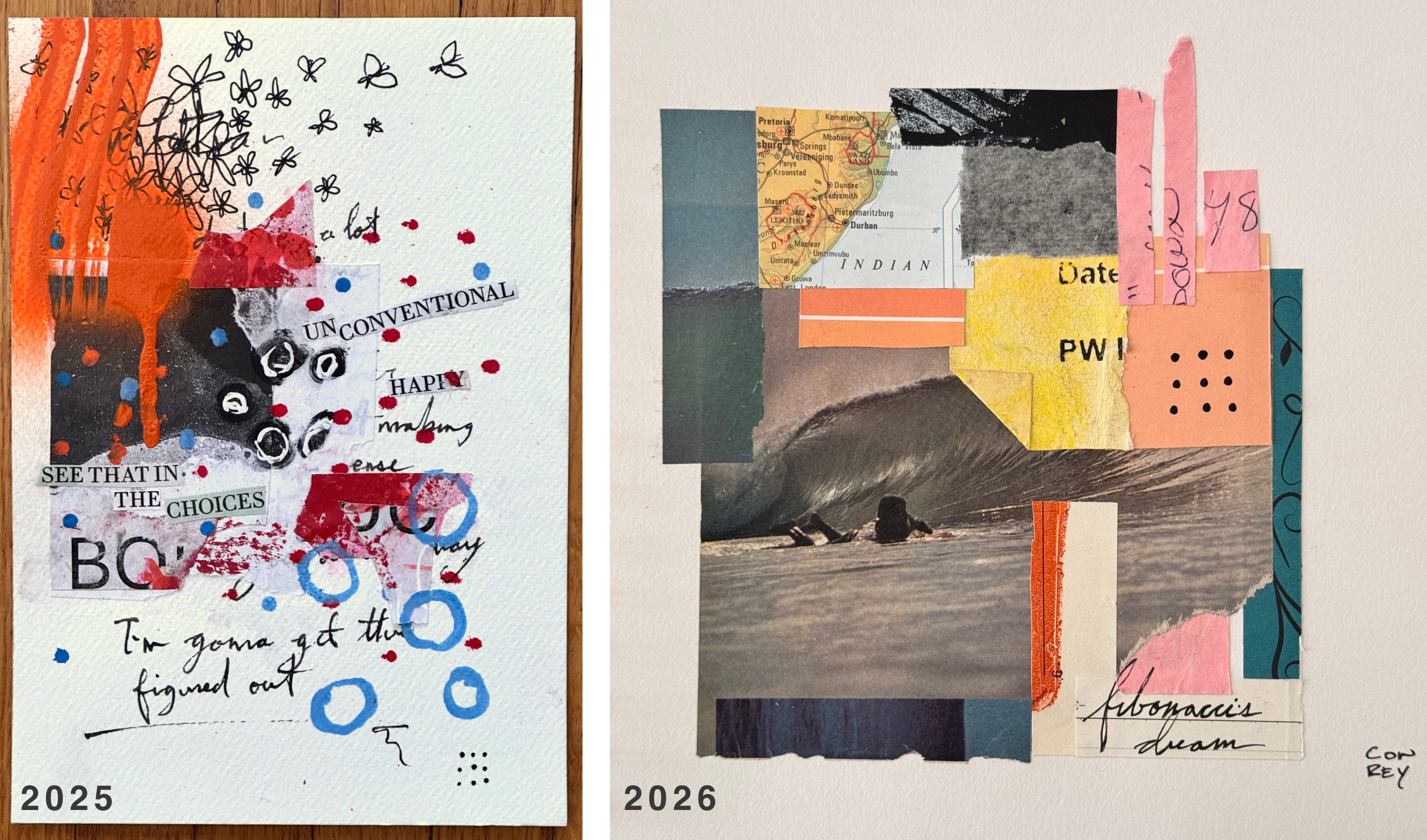
My work is always starts from intuition; I rarely have a theme, idea, or goal in mind. I work impulsively and all-too-often, it’s only finished when I’ve run out of space, or I’ve overworked the piece. I’m trying to be more intentional with this current work, not just to slow things down, but also because I want what I produce to be replicable by others.
I’ve probably said too much, and smart people who know me well may be able to put the clues together, but the lesson that seems to keep smacking me in the face is that the creative experiments are not randomly divergent. They serve the purpose of lending lessons to everything I make. The photo work from June helped me understand that I can create the imagery I want and use those in my final projects as much as I can the images from the magazines I stole from my dentist’s office.
A.I.T.C.
This is by far the most important lesson, but also the easiest, with two simple steps.
↣ Clean the workspace. After cleaning off both my office and studio desks so that I could work, I came to the conclusion that I made them both impossible to work on as a way to sabotage myself. The clean(er) workspace made it much easier for me to say yes to working.
↣ Put your ass in the chair. I know it’s a simple and obvious thought, but when you are finding the resistance to get work done, perhaps you just need to see your ass down, grab a sketchbook, notepad, laptop, or canvas and make something, anything, even if it’s total crap.
I’ve done this for many days in a row, and this morning, I found myself wandering out to the studio without thinking about it. That’s a privilege I need to acknowledge—maybe you have other obligations, like kids and family, or those pesky jobs that actually require your attention in order to get the money you need for art supplies.
I know that sometimes the last thing you want to do is immediately jump into work after you’ve spent your energy on those other things, but if you if you have the power, AITC time is the best thing I’ve found to my productivity woes.
Coincidentally, I’m sitting in a chair right now, so there’s the receipts.
Connecting the Dots
I saw a short video recently where a person needed wrapping paper for a present, but didn’t have any, so they used crate paper they had in the studio and with some stamps and paint pens, made their own. However, this wasn’t your auntie’s craft project, because upon deeper investigation, the style and motifs were carried over from her creative work.
Not only does the receiver of the gift get a second gift with the hand-decorated paper, but they get a reminder of the talent of the artist. If there was a party involved, every person at that party was likely steaming with jealousy of how that one package sat prominently against the backdrop of all the store-bought bags and wrappings.
It made me wonder how much that artist carried over her style and motifs into other parts of her life. Need cloth napkins? Dye them yourself. Want to repaint your table lamps? Get down with your bad self. Whether they’re making canvases, home goods, gift bags, or painting the walls of their studio.
Again, this may seem obvious, but how often have you turned to the easy approach to something like wrapping paper and gift cards instead of making your own, in your style, as a reminder to your friends and family that you make cool shit and they should buy all of it?
As I write this, I feel like I’m just scratching the surface of this idea, and it would require changing my thinking around everything. “Could I make this myself?” That should be the pervasive question, and I’m going to do my best to consider it whenever I find myself in consumption mode.
The more I do this, the more I’ll share.
Cheers,
Dave
Just a thank you for not locking this. I understand the need for paywalls, but would rather avoid them with my work and it kills me the people who saying their article is necessary and an unveiling then lock in two paragraphs in make themselves liars. Anything so important couldn’t possibly be a reality, even if it had the numbers.
Logical fallacy of “YOU MUST READ THIS. SAVE OUR COUNTRY.” Hitting the “pay-to-continue reading”